
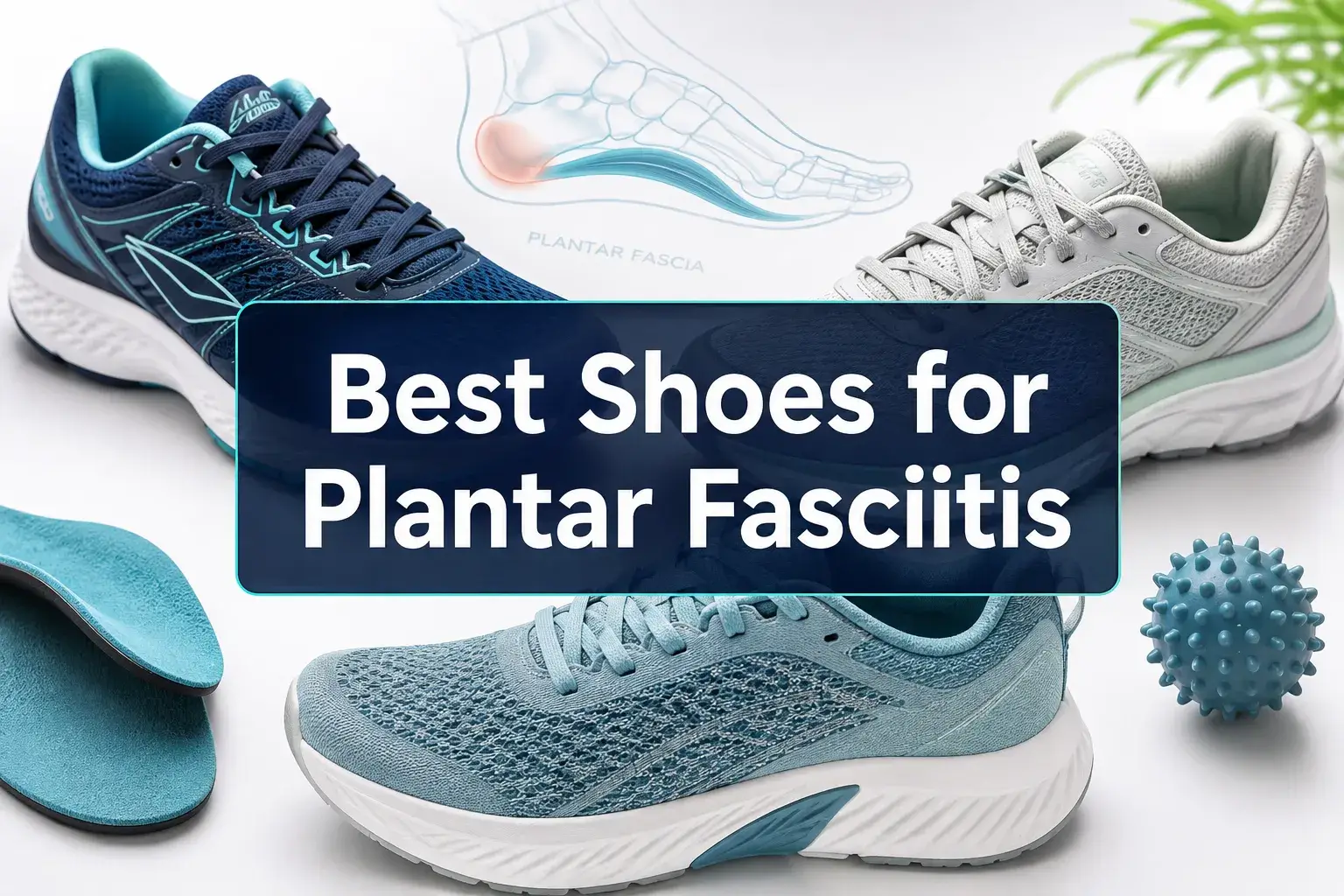
Quick Answer: The best shoes for plantar fasciitis combine firm arch support, deep heel cushioning, a rigid heel counter, and a slightly rocker-style sole to reduce stress on the plantar fascia. Leading podiatrist-recommended brands in 2026 include Brooks, HOKA, New Balance, Asics, and Saucony. Choosing the right pair based on your foot type, daily activity, and budget is the single most effective non-invasive step most people can take to reduce heel pain.
Table of Contents
Key Takeaways
- Plantar fasciitis affects roughly 2 million Americans annually, and footwear is one of the most controllable risk factors [4]
- The four non-negotiable shoe features are: structured arch support, deep heel cushioning, a firm heel counter, and a stable midsole [1]
- Budget-friendly shoes ($60,$100) can provide meaningful relief, but mid-range options ($100,$180) typically offer better long-term durability and clinical-grade support [7]
- Custom orthotics and supportive shoes work best together; orthotics alone inside flat shoes rarely solve the problem [6]
- Running shoes, walking shoes, and work shoes each have different structural priorities for plantar fasciitis sufferers
- Flat shoes, flip-flops, and unsupported sandals are the most damaging footwear choices for this condition [3]
- Most people notice measurable pain reduction within two to six weeks of switching to properly supportive footwear [9]
- Women and men share the same core feature requirements, but women’s lasts tend to be narrower, affecting fit and support distribution [6]
- Over-the-counter insoles can meaningfully upgrade a moderately supportive shoe without requiring custom orthotics [8]
- APMA-accepted shoes (those carrying the American Podiatric Medical Association seal) are a reliable starting filter when shopping [5]

What Is Plantar Fasciitis and Why Does Footwear Matter
Plantar fasciitis is inflammation of the plantar fascia, a thick band of connective tissue running along the bottom of the foot from the heel bone to the toes. It is the most common cause of heel pain, responsible for an estimated 10% of all running-related injuries and affecting people who stand for long hours as much as athletes [4].
Footwear matters because every step loads the plantar fascia with force equal to roughly 1.25 times body weight during walking and up to three times body weight during running. Shoes that lack adequate arch support, heel cushioning, or structural stability increase that load and prevent the fascia from recovering between steps. Conversely, well-designed supportive shoes distribute force more evenly, reduce peak stress at the heel insertion point, and allow the tissue to heal [1].
The bottom line: Footwear is not a cure for plantar fasciitis, but the wrong shoes actively worsen it and the right shoes are a foundational part of any recovery plan.
What Shoe Features Help Plantar Fasciitis: Arch Support, Heel Cushioning, and More
The best shoes for plantar fasciitis share four structural features that podiatrists and biomechanics researchers consistently prioritize in 2026 [1][4][9]:
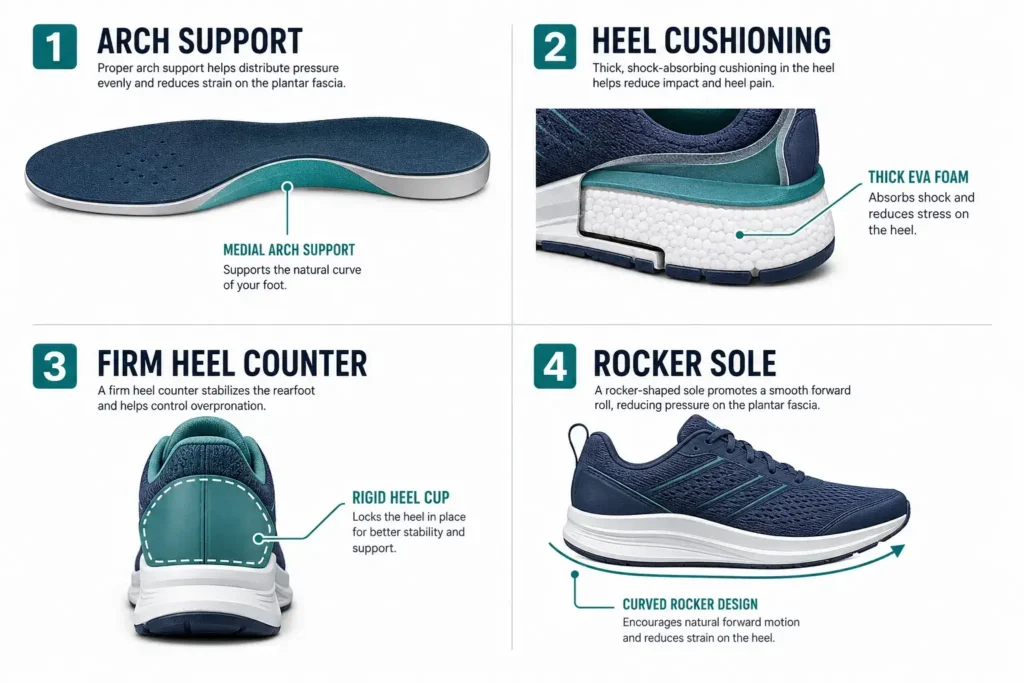
- Firm, contoured arch support: A built-in medial arch support (not just a flat insole) reduces the stretch placed on the plantar fascia with each step. Semi-rigid is better than fully rigid for most people.
- Deep heel cup: A cupped heel cradles the fat pad under the heel bone, preventing it from splaying outward and absorbing shock more efficiently.
- Thick, shock-absorbing midsole: Materials like EVA foam, PEBA foam (used in HOKA’s PROFLY+), or polyurethane slow the rate of impact force transmission to the heel.
- Firm heel counter: The rigid back section of the shoe controls rear-foot motion. Excessive inward rolling (overpronation) is a primary mechanical driver of plantar fasciitis.
- Rocker or curved sole: A mild rocker geometry reduces the range of motion required at the ankle and forefoot, lessening the pull on the fascia at toe-off.
- Wide toe box: Allows natural toe splay, reducing compensatory tension through the arch.
“The most common mistake people make is buying a shoe that feels soft and cushioned at first touch in the store, but lacks structural support in the midsole. Softness and support are not the same thing.”, consensus view from multiple podiatrist sources [9][6]
Avoid: Flexible, foldable soles; zero-drop flats; thin-soled canvas shoes; and any shoe where you can easily twist the midsole like a towel.
Best Shoes for Plantar Fasciitis in 2026: Top Picks by Category
The best shoes for plantar fasciitis in 2026 fall into a few clear categories. These are the models that appear most consistently across podiatrist recommendations, APMA-accepted lists, and independent testing panels [5][7][9][10]:
Best overall walking/everyday shoes:
- Brooks Ghost 16 (neutral, high cushion, excellent heel counter)
- HOKA Bondi 8 (maximum cushion, rocker sole, wide toe box)
- New Balance 990v6 (stability, motion control, durable for all-day wear)
Best for running:
- Brooks Adrenaline GTS 24 (GuideRails motion control, strong arch support)
- Asics Gel-Kayano 31 (gel heel cushioning, medial post for overpronators)
- Saucony Guide 17 (lightweight stability, good for mild to moderate pronation)
Best for work/standing all day:
- Dansko Professional Clog (rocker bottom, rigid shank, APMA accepted) [5]
- New Balance 626v2 (slip-resistant, wide widths, structured support)
- HOKA Transport (hybrid work-casual, thick midsole, low heel-to-toe drop)
Best non-bulky/casual look:
- On Cloudmonster (cushioned but sleek silhouette)
- Brooks Adrenaline GTS (available in neutral colorways)
- Kizik Athens (hands-free entry, supportive insole, everyday aesthetic)
Best Plantar Fasciitis Shoes for Running
For runners, the best plantar fasciitis shoes prioritize motion control and impact absorption over pure lightness. A stability shoe with a heel drop between 8mm and 12mm is the standard clinical recommendation for most plantar fasciitis sufferers who overpronate [4][8].
The Brooks Adrenaline GTS 24 and Asics Gel-Kayano 31 consistently rank at the top of independent running shoe tests for this condition. Both offer medial post technology (a denser foam on the inner midsole) that corrects overpronation without requiring a rigid orthotic [4].
Choose a stability shoe if you notice your arches collapsing inward when you look at old shoe wear patterns (excessive wear on the inner heel edge).
Choose a neutral cushioned shoe (like HOKA Bondi 8) if you have high arches and a supinated gait.
Best Plantar Fasciitis Shoes for Work or Standing All Day
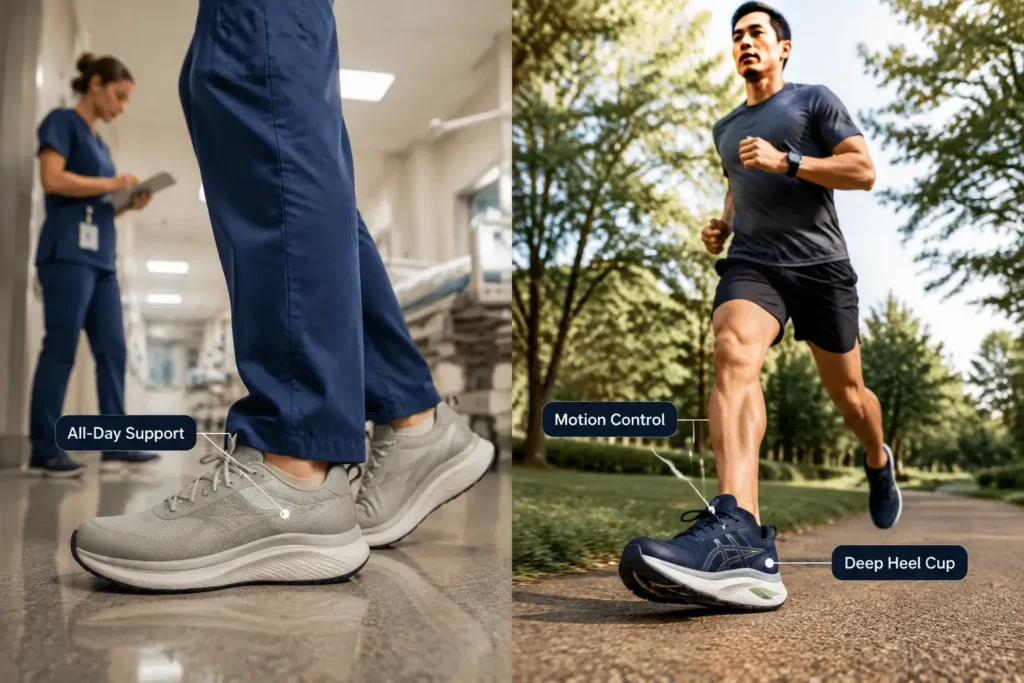
For people who stand on hard floors for eight or more hours, the priority shifts from motion control to sustained cushioning and a rocker sole that reduces forefoot fatigue [3][10].
Clogs with a built-in rocker bottom, such as the Dansko Professional, are APMA-accepted and widely recommended by nurses, teachers, and retail workers [5]. For those who need a more traditional shoe appearance, the New Balance 626v2 and HOKA Transport offer the same structural benefits in a lace-up format.
Key criteria for work shoes:
- Removable insole (to accommodate custom orthotics)
- Slip-resistant outsole for safety on wet floors
- Wide toe box to prevent forefoot cramping after hours of standing
- At least 20mm of midsole stack height at the heel
Plantar Fasciitis Shoes vs. Orthotics: Which Works Better
Supportive shoes and orthotics are complementary, not competing solutions. A well-structured shoe alone can provide significant relief for mild to moderate plantar fasciitis, while custom orthotics become more important for severe cases or unusual foot geometries [6][8].
The critical point: placing a custom orthotic inside a flat, unsupportive shoe produces poor results. The shoe’s midsole must provide a stable base for the orthotic to function correctly. Think of the shoe as the foundation and the orthotic as fine-tuning.
Over-the-counter insoles (such as Superfeet Green or Powerstep Pinnacle) cost $30,$60 and can meaningfully upgrade a moderately supportive shoe. Custom orthotics from a podiatrist typically cost $300,$600 and are warranted when OTC options and supportive shoes have not resolved pain after six to eight weeks [6].
How Much Should You Spend on Plantar Fasciitis Shoes
Effective plantar fasciitis shoes are available across a wide price range. Budget options ($60,$100) can provide real structural support, but mid-range shoes ($100,$180) typically use higher-quality foam compounds that maintain their cushioning properties longer [7].
| Price Range | What You Get | Best For |
|---|---|---|
| Under $80 | Basic arch support, moderate cushion, shorter lifespan | Mild symptoms, occasional wear |
| $80,$130 | Structured midsole, firm heel counter, wider width options | Daily wear, moderate symptoms |
| $130,$180 | Premium foam, rocker geometry, APMA-accepted models | Chronic pain, high activity levels |
| Over $180 | Carbon-plated or specialty orthopedic construction | Competitive runners, severe cases |
Can cheap shoes help plantar fasciitis? Yes, if they have the right structural features. Price alone does not determine effectiveness. A $75 New Balance with a firm midsole will outperform a $200 fashion sneaker with a flat insole every time [7].
Worst Shoes to Wear With Plantar Fasciitis: What to Avoid
Certain shoe types consistently worsen plantar fasciitis by increasing tensile load on the fascia or eliminating the heel support the condition requires [3][9].
Avoid these shoe types:
- Flat ballet flats and canvas sneakers (no arch support, no heel cushion)
- Flip-flops and backless sandals (no heel counter, forces toe gripping)
- High heels above 2 inches (shortens the Achilles tendon, increases forefoot load)
- Worn-out athletic shoes (midsole foam compresses after 300-500 miles; replace regularly)
- Minimalist or zero-drop shoes (appropriate for healthy feet, harmful during active plantar fasciitis)
- Barefoot walking on hard floors (especially first thing in the morning, when the fascia is tightest)
Plantar Fasciitis Shoes for Flat Feet vs. High Arches
Flat feet and high arches require opposite shoe interventions, and choosing the wrong type can make plantar fasciitis worse even in an otherwise supportive shoe [1][8].
Flat feet (low arches, overpronation):
- Need motion-control or stability shoes with a medial post
- Look for a firm inner midsole edge and a structured arch
- Recommended: Brooks Adrenaline GTS, Asics Gel-Kayano, New Balance 860
High arches (supination/underpronation):
- Need neutral cushioned shoes with maximum shock absorption
- Avoid motion-control shoes, which can force the foot into an unnatural position
- Recommended: HOKA Bondi 8, Brooks Ghost, Saucony Ride
Quick test: Wet your foot and step on a paper bag. A nearly complete footprint indicates flat feet; a narrow band connecting heel and forefoot indicates high arches.
Plantar Fasciitis Shoes for Women vs. Men: Key Differences
The core feature requirements are identical for women and men, but the physical construction differs in ways that affect fit and support quality [6].
Women’s lasts (the mold shoes are built on) are typically narrower through the heel and midfoot, with a wider forefoot relative to heel width. This means a women’s-specific shoe will distribute arch support pressure more accurately across a woman’s foot than a men’s shoe in a smaller size.
Men’s plantar fasciitis shoes tend to offer more width options (2E, 4E) for wider feet, which is relevant because a shoe that is too narrow compresses the midfoot and disrupts arch support mechanics.
Recommendation: Always buy gender-specific lasts when possible, and prioritize trying on shoes in the afternoon when feet are at their largest.
Do You Need Custom Insoles With Plantar Fasciitis Shoes
Not always. Many people achieve full symptom relief using a well-structured shoe with a quality over-the-counter insole. Custom orthotics are worth pursuing when [6][8]:
- Symptoms persist after 6-8 weeks of wearing supportive shoes
- A podiatrist identifies a specific biomechanical issue (leg length discrepancy, severe overpronation)
- The foot shape is unusual enough that standard insoles do not make contact with the arch
For most people starting out, a $35,$55 OTC insole like Superfeet Green (for low arches) or Superfeet Blue (for medium arches) inside a supportive shoe is the most cost-effective first step.
How Long Does It Take for New Shoes to Help Plantar Fasciitis
Most people notice a reduction in morning heel pain within two to four weeks of consistently wearing supportive shoes. Full resolution of symptoms typically takes six to twelve weeks, depending on the severity of inflammation and whether other treatments (stretching, ice, physical therapy) are used alongside footwear changes [9][10].
Factors that speed recovery:
- Wearing supportive shoes from the first step out of bed (not walking barefoot to the bathroom)
- Replacing shoes before the midsole is fully compressed
- Combining footwear with daily calf and plantar fascia stretching
- Avoiding prolonged standing on hard surfaces without cushioned footwear
If pain does not improve after 8-12 weeks of wearing appropriate shoes, consult a podiatrist. Persistent cases may require corticosteroid injections, physical therapy, or in rare cases, surgical intervention.
Plantar Fasciitis Shoes That Don’t Look Medical or Bulky
Supportive shoes no longer have to look orthopedic. Several brands have closed the gap between clinical function and everyday style [7][10].
- On Cloudmonster / Cloudstratus, Swiss-designed, sleek silhouette, strong cushioning platform
- Kizik Athens, hands-free entry, clean casual look, built-in arch support
- Brooks Ghost 16, available in neutral colorways that work with casual outfits
- Birkenstock Arizona with soft footbed, sandal option with deep heel cup and contoured arch (appropriate for mild symptoms and warm weather)
- HOKA Clifton 9, lower-profile than the Bondi, still substantial cushioning, cleaner aesthetic
The key is to look for shoes where the midsole stack height is distributed evenly rather than concentrated only at the heel, which creates a more balanced visual profile.
FAQ
Can plantar fasciitis go away just by changing shoes?
For mild to moderate cases, yes. Switching to properly supportive footwear is often sufficient when combined with stretching. Severe or long-standing cases typically need additional treatment.
What is the single most important shoe feature for plantar fasciitis?
Firm, contoured arch support is the most critical feature. It directly reduces the tensile load on the plantar fascia with every step.
Are HOKA shoes good for plantar fasciitis?
Yes. HOKA’s thick midsole and rocker geometry are well-suited to plantar fasciitis. The Bondi 8 and Clifton 9 are the most commonly recommended models [9][10].
Should I wear plantar fasciitis shoes all day, even at home?
Ideally, yes. Walking barefoot on hard floors, especially first thing in the morning, is one of the most common aggravating factors. House slippers with arch support (such as Vionic or Oofos) are a practical solution [3].
How often should I replace my shoes if I have plantar fasciitis?
Athletic shoes should be replaced every 300-500 miles or every 6-12 months for daily walkers. A compressed midsole loses 30-40% of its shock-absorbing capacity and can worsen symptoms even if the upper looks intact [4].
Are stability shoes or neutral shoes better for plantar fasciitis?
It depends on your gait. Overpronators benefit from stability shoes with a medial post. Neutral or supinating gaits do better in well-cushioned neutral shoes. If you’re unsure, a gait analysis at a running specialty store takes about 10 minutes and is usually free.
Can I use plantar fasciitis shoes for both running and everyday wear?
Running shoes are designed for forward motion and may feel stiff for casual walking. A walking or cross-training shoe is generally more comfortable for all-day wear. Having separate pairs for running and daily use extends the life of both.
What is the best brand overall for plantar fasciitis shoes?
Brooks, HOKA, and New Balance appear most consistently across podiatrist recommendations and independent testing panels in 2026 [7][9][10]. No single brand is universally best, fit and foot type matter more than brand loyalty.
Conclusion : What Are the Best Shoes for Plantar Fasciitis
Plantar fasciitis is painful and persistent, but footwear is one of the most controllable variables in recovery. The best shoes for plantar fasciitis combine firm arch support, a deep heel cup, a shock-absorbing midsole, and a stable heel counter. These features are available at multiple price points, from budget-friendly options under $80 to premium clinical-grade models above $150.
Actionable next steps:
- Identify your foot type (flat, neutral, or high arch) using the wet-foot test before shopping.
- Prioritize shoes with a firm midsole over shoes that simply feel soft at first touch.
- Add a quality OTC insole (Superfeet or Powerstep) if the shoe’s factory insole lacks arch contour.
- Replace athletic shoes every 300-500 miles, regardless of how the upper looks.
- Wear supportive footwear from the first step each morning, including at home.
- If pain persists beyond eight weeks despite proper footwear, consult a podiatrist for a biomechanical assessment.
The right pair of shoes will not fix plantar fasciitis overnight, but they create the conditions in which healing becomes possible. That is a practical, affordable, and evidence-supported place to start.
References
[1] Best Shoes For Plantar Fasciitis – https://goholistiq.com/best-shoes-for-plantar-fasciitis/
[2] Best Shoes For Plantar Fasciitis Pain Relief Guide – https://www.gravitydefyer.com/blogs/news/best-shoes-for-plantar-fasciitis-pain-relief-guide
[3] Shoes For Plantar Fasciitis – https://www.michiganfootdoctors.com/shoes-for-plantar-fasciitis/
[4] Best Plantar Fasciitis Sneakers – https://runrepeat.com/guides/best-plantar-fasciitis-sneakers
[5] Comfortable Walking Shoes – https://www.health.com/style/comfortable-walking-shoes
[6] Best Shoes For Plantar Fasciitis – https://sportydoctor.com/best-shoes-for-plantar-fasciitis/
[7] Best Comfortable Shoes For Plantar Fasciitis – https://www.businessinsider.com/guides/health/best-comfortable-shoes-for-plantar-fasciitis
[8] Best Plantar Fasciitis Walking Shoes – https://runrepeat.com/guides/best-plantar-fasciitis-walking-shoes
[9] The Best Shoes For Plantar Fasciitis – https://www.cnn.com/cnn-underscored/health-fitness/the-best-shoes-for-plantar-fasciitis
[10] Best Shoes For Plantar Fasciitis – https://www.everydayhealth.com/product-reviews/best-shoes-for-plantar-fasciitis/