
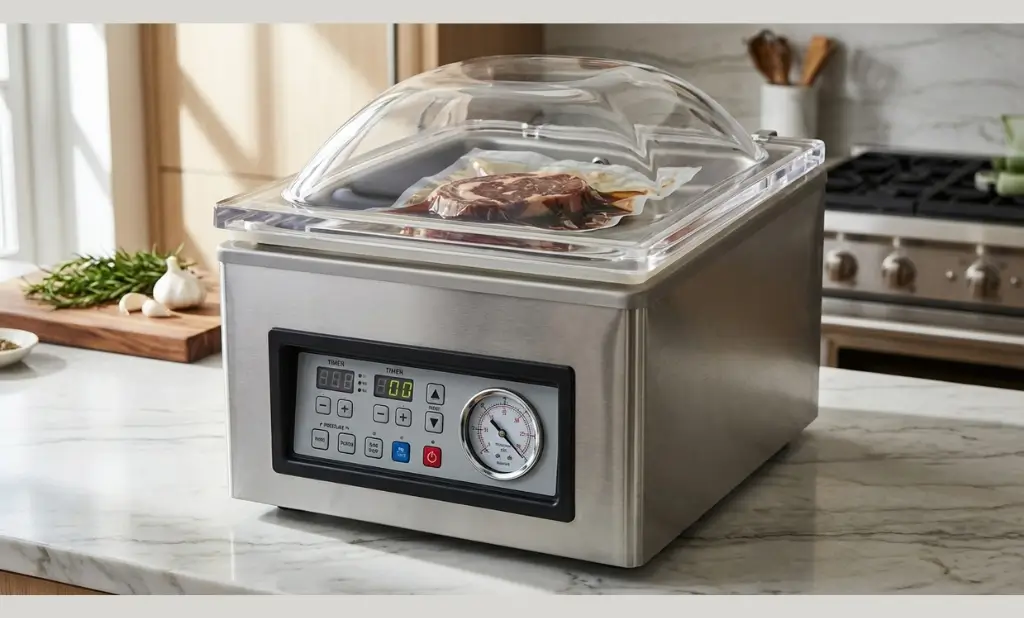
You know the feeling. You buy beautiful rib eyes on sale, freeze them carefully, and three months later they’re covered in ice crystals and taste like cardboard. Or you marinate chicken breasts in your countertop sealer, only to watch half the liquid get sucked out before the bag even closes.
Professional kitchens don’t deal with these problems because they use different equipment. The chamber vacuum sealer, once found only in restaurant kitchens and processing facilities, has become increasingly accessible for serious home cooks. If you’ve been frustrated by the limitations of standard vacuum sealers, understanding how these machines work might change how you think about food storage entirely.
Table of Contents
How Chamber Vacuum Sealers Actually Work
The key difference between a chamber vacuum sealer and the handheld or countertop suction models most people own comes down to where the air gets removed. Standard edge sealers create suction at the open end of the bag, pulling air out through that opening. This works fine for solid foods, but it’s why liquids get sucked into the machine and why delicate items get crushed.
A chamber vacuum sealer takes a completely different approach. You place the entire bag, open end and all, inside a chamber. The machine removes air from the whole chamber at once, which means the air inside the bag and outside the bag equalizes. There’s no suction force pulling at your food or liquids.
Once the air is evacuated, the machine heat seals the bag, then releases the vacuum. The outside air pressure does the work of compressing everything into a tight seal. This process explains why chamber sealers can handle tasks that would be impossible with conventional models.
The Real Advantage with Liquids
If you’ve ever tried sealing soup, marinade, or any sauce with a regular vacuum sealer, you understand the frustration. The machine starts sucking, the liquid rushes toward the opening, and you end up with a mess and a failed seal. Some people freeze liquids first or use tricks like hanging the bag off the counter edge, but these workarounds are tedious.
Chamber vacuum sealers eliminate this problem completely. Because the pressure equalizes rather than creating suction, liquids stay exactly where you put them. You can seal a bag of tomato sauce, beef stock, or curry without losing a drop. Marinating becomes faster too.
Sealing meat with marinade in a chamber sealer means the liquid penetrates deeper as the vacuum removes air pockets from the surface of the protein. What might take hours in a zip bag happens in minutes with a proper seal. For anyone who batch cooks or meal preps, this capability alone justifies the learning curve.
Techniques Beyond Basic Storage
Once you own a chamber vacuum sealer, you start noticing applications that go beyond simply preventing freezer burn. Compression is one of the more interesting techniques. Sealing watermelon or pineapple under vacuum changes the texture, making it denser and more jewel-like. The same process works with quick pickles. Slice cucumbers, add brine to a bag, seal it, and the vacuum forces the liquid into the vegetable much faster than traditional pickling methods.
Sous vide cooking becomes more reliable with chamber-sealed bags. The consistent seal means no air pockets that could cause your steak to float or cook unevenly. The bags also tend to be more affordable since chamber sealers work with smooth bags rather than the textured, channeled bags that edge sealers require.
If you’re already invested in precision cooking methods, the chamber vacuum sealer integrates seamlessly into that workflow. It handles delicate fish fillets without crushing them, and you can seal portions of softer vegetables without turning them to mush.
What Ownership Actually Looks Like
The practical realities matter here. Chamber vacuum sealers are larger than countertop suction models. Most home units measure roughly the size of a microwave, and they need permanent counter space or dedicated storage where you can access them easily. They’re heavy too, typically between 30 and 50 pounds, so this isn’t something you’ll want to haul in and out of a cabinet regularly.
Cost represents another consideration. Entry-level chamber models start around $400 to $500, with more robust options running $800 or higher. That’s substantially more than a basic edge sealer. However, the long-term economics can work in your favor. The smooth bags cost significantly less than textured bags, and many chamber sealer bags can be washed and reused multiple times.
If you’re currently throwing away food because of freezer burn or spoilage, or if you’re buying small quantities because you can’t preserve larger amounts effectively, a chamber vacuum sealer shifts those calculations. The machine pays for itself through better ingredient management and reduced waste.
Top Picks for Home Kitchens
If you are ready to reclaim your freezer space, you don’t need a machine the size of a dishwasher. A new generation of “compact commercial” sealers has hit the market, designed specifically for residential counters. Here are two distinct options that balance power with footprint.
1. The Compact Favorite: Avid Armor USV20 Ultra Series
Best for: Small urban apartments and design-conscious cooks.
This is arguably the darling of the home-chamber world right now. With over 800 units flying off the shelves this month alone, the Avid Armor USV20 strikes a sweet spot between performance and size. It’s designed specifically to tackle wet foods soups, marinades, and stews without the bulk of traditional commercial units.

- Ensures Leak-Free Sealing – Keep your liquid-rich foods fresh for longer with the Avid Armor food vacuum sealer machine….
- Why it works: It features an 11.5-inch sealing bar which is plenty for standard family-sized portions, and users consistently rate it highly (4.7/5 stars) for reliability.
- The Vibe: It’s sleek, unintimidating, and comes from a small business, which often means better attention to customer detail.
- Price: ~$349.00 (Free delivery)
2. The Heavy-Duty Powerhouse: VEVOR DZ-260C
Best for: Hunters, bulk shoppers, and “pro-sumer” cooks who prioritize raw power.
If you care more about the seal than the aesthetics, this machine is a beast. The VEVOR DZ-260C is built like a tank (weighing in at 60 lbs!) and brings true commercial specs into the home. It pulls a massive -100KPa of vacuum pressure, meaning it removes nearly all air to block oxidation completely.
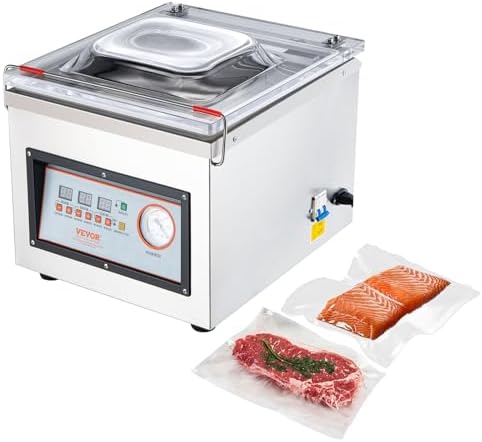
- -100KPa Vacuum Power: This vacuum sealer nearly removes all air to block oxidation and slow spoilage. Meat and seafood …
- Why it works: It features a wider 10mm heating strip (double the width of many competitors), ensuring a “dual lock” seal that won’t pop open in the freezer. It also includes a real-time pressure gauge, giving you total control so you don’t accidentally crush delicate items like chips or soft breads.
- The Vibe: Industrial and utilitarian. It’s made of stainless steel designed to resist rust even with salty marinades, making it a favorite for people who process their own meats or buy in serious bulk.
- Price: ~$330.99 (Great value for the specs)
Choosing What Makes Sense for Your Kitchen
Not everyone needs a chamber vacuum sealer, and that’s perfectly fine. If you only occasionally freeze leftovers or seal the odd steak, a basic suction model probably handles your needs adequately. But certain cooking styles and shopping habits align naturally with what chamber sealers do best.
Do you buy proteins in bulk when they’re on sale? Do you make stocks, sauces, or soups in large batches? Are you interested in sous vide cooking or fermentation projects? Do you garden or buy produce in season to preserve for later? If several of these situations describe your cooking life, a chamber vacuum sealer becomes less of a luxury and more of a practical tool.
The machine also makes sense for households that value ingredient quality and want to maintain that quality from purchase to plate. Vacuum sealing extends the freezer life of most foods by two to three times compared to conventional storage methods.
The Sensory Payoff
There’s something satisfying about the results a chamber vacuum sealer produces. The seal itself looks different. Instead of the slightly wrinkled, sometimes uneven closure you get from suction sealers, chamber-sealed bags have smooth, clean seals. The plastic conforms perfectly to whatever you’re sealing, hugging the contours of a salmon fillet or creating neat rectangular blocks of portioned soup.
Open your freezer and you’ll see the difference immediately. Flat, stackable packages that use space efficiently. No bulky, air-filled bags taking up room. The food inside looks vibrant because the tight seal prevents oxidation and moisture loss.
A properly sealed ribeye pulled from the freezer six months later looks nearly identical to the day you sealed it. The machine itself operates with a low hum rather than the loud suction noise of conventional models, which feels fitting for a more professional approach to food storage.
Making the Investment Work for You
A chamber vacuum sealer represents a shift in how you manage your kitchen. It’s not just another gadget that promises convenience. It’s a piece of equipment that assumes you’re willing to think strategically about ingredients, shopping, and meal planning. When you commit that counter space and budget, you’re essentially deciding that food quality and waste reduction matter enough to change some habits.
The best approach is to start by honestly assessing your current patterns. How much food do you waste each month? How often do you avoid buying in bulk because you can’t store it properly? How much do you spend on smaller, more frequent shopping trips? If those numbers add up, and if you’re genuinely interested in techniques like sous vide or preservation, a chamber vacuum sealer moves from “nice to have” to “actually makes sense.”
For the serious home cook, it’s one of those tools that quietly improves dozens of small processes, and over time, those improvements compound into genuinely better cooking and less frustration with storage. That’s a worthwhile return on the investment.
Frequently Asked Questions
What is a chamber vacuum sealer?
A chamber vacuum sealer is a food preservation device that removes air from specially designed bags by evacuating the entire sealing chamber rather than using suction. Unlike edge sealers that pull air through the bag opening, chamber models place the whole bag inside an enclosed space, remove air from that space, then heat seal the bag before releasing the vacuum. This method allows for sealing liquids, delicate foods, and achieving more consistent results than conventional vacuum sealers.
How does a vacuum chamber work?
A vacuum chamber works by creating a sealed environment and using a pump to remove air molecules from that space. When you place a food bag inside and close the chamber lid, the pump evacuates air from the entire chamber, which equalizes the pressure inside and outside the bag. Once the desired vacuum level is reached, a heating element seals the bag closed. When the chamber is opened and air rushes back in, atmospheric pressure compresses the bag tightly around the contents. This process takes anywhere from 20 to 40 seconds depending on the machine and settings.
Is a chamber vacuum sealer better?
A chamber vacuum sealer is better for specific applications, particularly sealing liquids, marinades, and delicate foods that would be crushed by suction sealers. They also use less expensive smooth bags and provide more consistent seals. However, they cost more upfront, take up significant counter space, and weigh considerably more than edge sealers. Whether one is better for you depends on how often you preserve food, whether you need to seal liquids, and if you have space and budget for the larger equipment. For occasional use with solid foods only, a standard edge sealer works fine.
What happens to a body in a vacuum chamber?
This question relates to human exposure to vacuum environments, which is outside the scope of food preservation equipment. Chamber vacuum sealers used in kitchens operate at relatively mild vacuum levels suitable for food packaging. They’re designed exclusively for sealing food items in bags and have safety features that prevent operation when the chamber is improperly closed. If you’re interested in the scientific or medical aspects of vacuum exposure, that’s a separate topic from kitchen vacuum sealing equipment.