
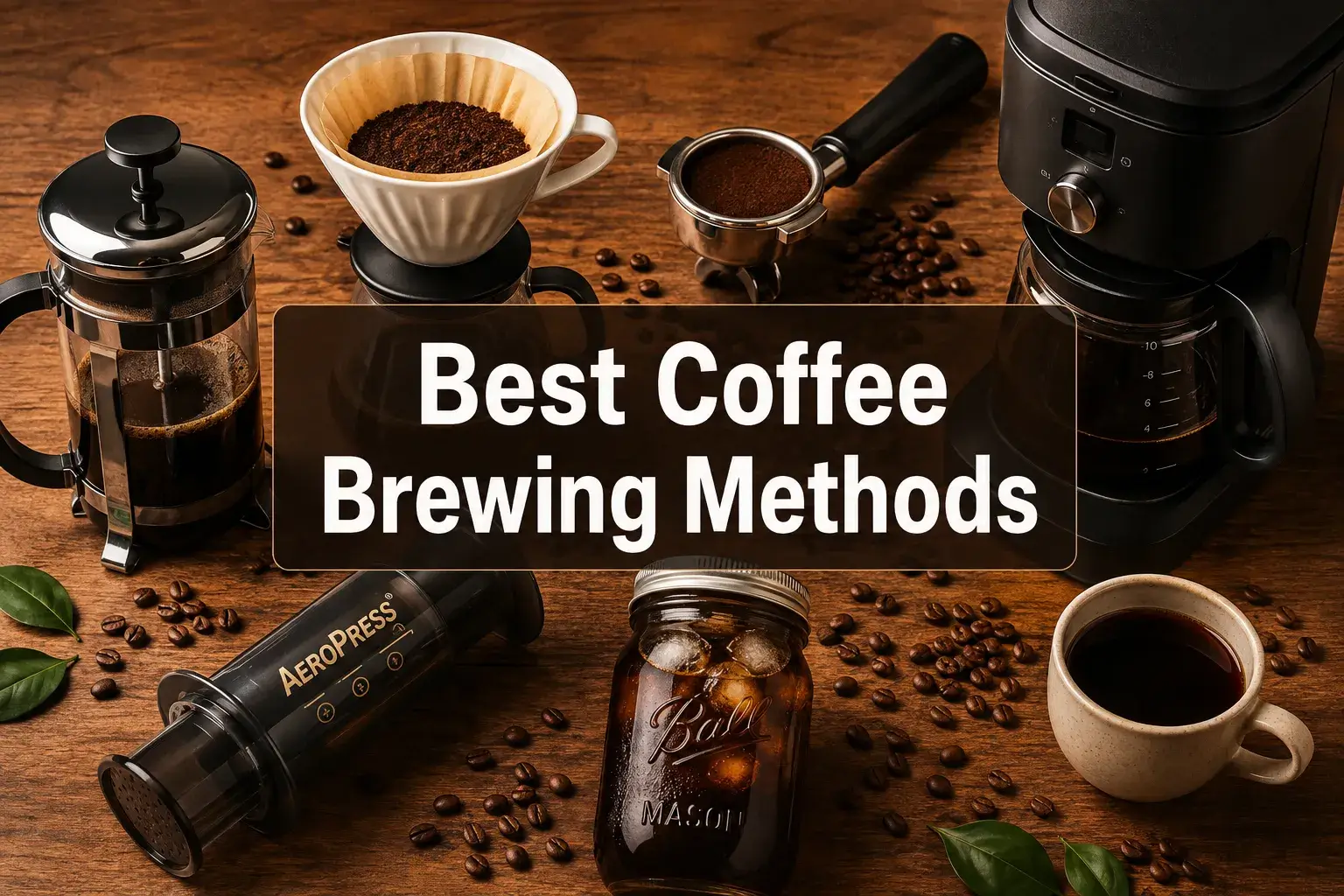
Quick Answer: The best coffee brewing methods depend on what you value most: taste clarity, body, strength, speed, or cost. Pour over and French press are the top choices for flavor-focused home brewers, espresso delivers the most concentrated cup, and cold brew wins for smoothness. Understanding what are the best coffee brewing methods and their differences helps you match the right technique to your beans, schedule, and gear budget.
Table of Contents
Key Takeaways
- Pour over produces the cleanest, brightest cup; French press delivers the heaviest body with more oils
- Espresso is the most concentrated method, not necessarily the highest in total caffeine per serving
- Cold brew is smoother and less acidic than hot brew, but takes 12 to 24 hours
- AeroPress is the best all-around method for beginners and travelers
- Drip machines are the most practical choice for busy mornings
- Grind size matters as much as brewing method, mismatched grind is the top cause of bitter or weak coffee
- Entry-level equipment ranges from under $10 (AeroPress-style) to over $500 for a quality espresso machine
- Most coffee grounds should only be used once for best flavor extraction
Understanding the Core Brewing Categories
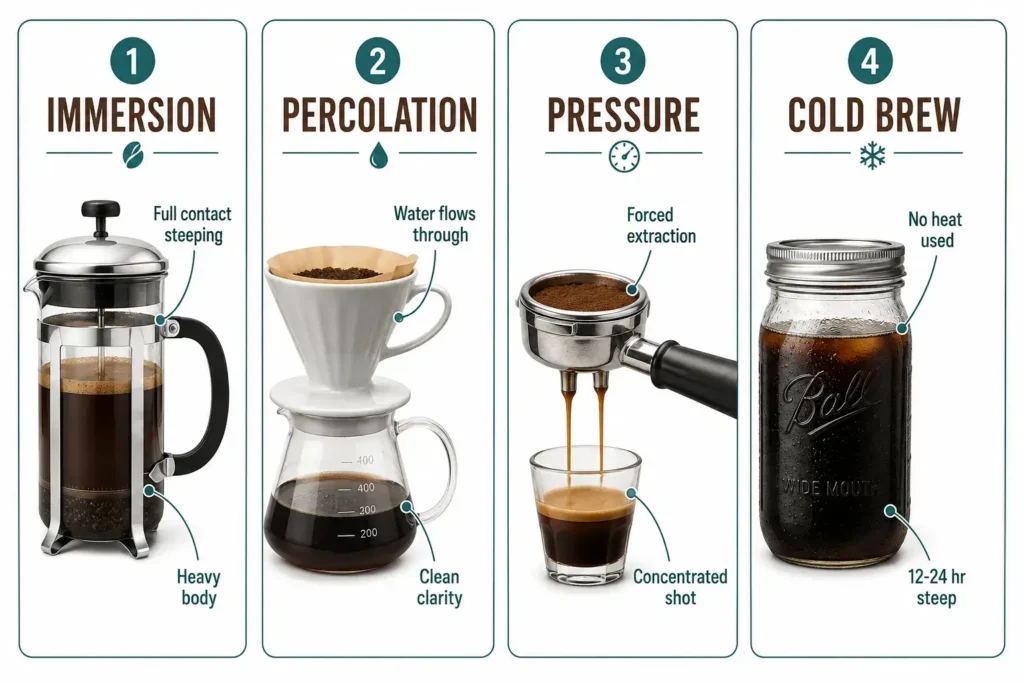
Before comparing individual methods, it helps to know that all coffee brewing falls into four basic categories: immersion, percolation, pressure, and cold extraction. Each category produces a fundamentally different cup.
- Immersion (French press, AeroPress): Grounds steep directly in water. Produces fuller body and more oils in the cup.
- Percolation (pour over, drip machine): Water flows through grounds once. Produces cleaner, brighter flavor with more clarity.
- Pressure (espresso, Moka pot): Water is forced through finely ground coffee under pressure. Produces concentrated, syrupy shots with crema.
- Cold extraction (cold brew): Grounds steep in cold or room-temperature water for 12 to 24 hours. Produces low-acid, smooth concentrate.
According to a detailed brewing method comparison guide, the extraction physics behind each category directly determines TDS (total dissolved solids), body, and flavor clarity, which is why switching methods with the same beans produces a noticeably different cup.
What’s the Difference Between Pour Over and French Press
Pour over and French press are the two most popular manual methods, but they produce very different results. Pour over uses a paper or metal filter and gravity, so water passes through grounds once, leaving a clean, tea-like cup with bright acidity. French press uses full immersion and a metal mesh plunger, so coffee oils and fine particles stay in the cup, creating a heavier, richer body.
Choose pour over if: you want to highlight floral or fruity notes in light-to-medium roasts, or you prefer a clear, crisp finish.
Choose French press if: you prefer a bold, full-bodied cup and don’t mind a little sediment at the bottom.
Brew time is similar, both take 3 to 5 minutes, but pour over requires more active attention (a steady spiral pour), while French press is mostly hands-off after the initial steep. Coffee brewing method comparisons consistently rank pour over higher for showcasing specialty beans, while French press wins for everyday ease.

- CRAFT COFFEE AT HOME: Produces six demitasse/espresso servings of rich, smooth e…
- DURABLE DESIGN: Carefully crafted with cast aluminum for long-lasting durability…
How Does Espresso Brewing Differ from Drip Coffee
Espresso forces hot water through finely ground coffee at roughly 9 bars of pressure in 25 to 30 seconds. Drip coffee lets gravity pull water through medium-ground coffee over 5 to 8 minutes. The result is dramatically different: espresso produces a 1 to 2 oz concentrated shot with a creamy layer called crema, while drip produces a 6 to 12 oz cup with lighter body and lower TDS.
A common misconception is that espresso has more caffeine. Per ounce, espresso is more concentrated, but a standard 8 oz drip coffee typically contains more total caffeine than a single espresso shot because of the larger volume. As this coffee extraction comparison explains, strength and caffeine content are related but not the same measurement.
Which Brewing Method Makes the Strongest Coffee
“Strongest” can mean most caffeinated or most concentrated. For concentration, espresso wins by a wide margin. For total caffeine per serving, cold brew concentrate and French press are often higher because they use a higher coffee-to-water ratio and longer contact time.
“Cold brew made with a 1:4 concentrate ratio can deliver significantly more caffeine per ounce than standard drip, but most people dilute it before drinking.”
For most coffee enthusiasts who want a strong but drinkable cup without espresso equipment, a French press with a 1:12 coffee-to-water ratio (stronger than the standard 1:15) is the most practical option.
Cold Brew vs Hot Brew Coffee: Which Is Better
Neither is objectively better, they serve different purposes. Cold brew (steeped 12 to 24 hours in cold water) is smoother, lower in acidity, and naturally sweeter because heat is never applied. Hot brew methods (drip, pour over, French press) extract flavor faster and highlight brighter, more complex aromatics that cold water cannot pull out.
Cold brew is better if: you have acid sensitivity, prefer drinking coffee over ice, or want to batch-brew a week’s worth at once.
Hot brew is better if: you want nuanced flavor from single-origin or specialty beans, or you need coffee ready in under 10 minutes.
According to a comprehensive brewing methods guide, cold brew retains its quality in the refrigerator for up to two weeks, making it one of the most practical options for high-volume home consumption.
Best Coffee Brewing Method for Beginners
The AeroPress is the best starting point for most beginners. It’s forgiving with grind size and water temperature, brews in under 2 minutes, produces a clean and strong cup, and costs around $35 to $45. It’s also nearly impossible to break.
For beginners who want a more hands-off experience, an automatic drip machine is the easiest daily driver. Set the timer the night before, and coffee is ready when you wake up. Home brewing tests consistently show that a mid-range drip machine with a built-in grinder satisfies most casual drinkers without requiring any technique.
Beginner method ranking by ease:
- Automatic drip machine
- AeroPress
- French press
- Pour over
- Moka pot
- Espresso machine
How Long Does Each Coffee Brewing Method Take
Brew time affects both your morning routine and the flavor in the cup. Here’s a practical breakdown:
| Method | Active Time | Total Time |
|---|---|---|
| AeroPress | 2 min | 2 min |
| Espresso | 5 min (with warmup) | 5-8 min |
| Drip machine | 1 min setup | 6-8 min |
| Pour over | 4-5 min active | 5-6 min |
| French press | 1 min setup | 4-5 min |
| Cold brew | 5 min setup | 12-24 hours |
What Equipment Do I Need and Which Method Is Cheapest
Equipment costs vary widely. Here’s a realistic range for 2026:
- French press: $15 to $60, just add a kettle and a grinder
- Pour over (V60 or Chemex): $20 to $80 for the dripper; add a gooseneck kettle ($30 to $80) and a burr grinder ($40 to $150)
- AeroPress: $35 to $45, works with any kettle
- Drip machine: $30 to $300 depending on features
- Moka pot: $25 to $60
- Espresso machine: $150 (entry-level) to $1,500+ for semi-automatic
The cheapest complete setup is a French press or AeroPress with a hand grinder, which can be assembled for under $60. Equipment cost comparisons for 2026 confirm that manual methods consistently outperform similarly priced automatic machines in cup quality.
Can I Use Any Coffee Beans for Any Brewing Method
Yes, but results vary significantly. Any coffee bean can technically be used in any method, but grind size and roast level should be matched to the brewing process for best results.
- Espresso: Fine grind, medium-dark to dark roast typically performs best under pressure
- Pour over: Medium grind, light to medium roast highlights clarity and origin character
- French press: Coarse grind, medium to dark roast; fine grinds create muddy, over-extracted cups
- Cold brew: Coarse grind, any roast; dark roasts produce a chocolatey concentrate
Using a light roast in a French press is perfectly valid, it just produces a different, sometimes grassier flavor than a medium roast would. Specialty coffee brewing guides recommend matching roast level to brewing method as one of the highest-impact adjustments a home brewer can make.
Why Does My Coffee Taste Bitter With This Brewing Method
Bitterness almost always signals over-extraction: too much flavor pulled from the grounds. The most common causes are grind too fine, water too hot, or brew time too long.
Quick fixes by method:
- Pour over: Coarsen the grind one step, or shorten your total pour time
- French press: Reduce steep time from 4 minutes to 3, or use a coarser grind
- Espresso: Coarsen the grind slightly or reduce shot time by 2 to 3 seconds
- Drip machine: Use slightly less coffee or a coarser grind setting
- Cold brew: Reduce steep time or use a 1:8 ratio instead of 1:4
Water temperature is also a factor. Brewing above 205°F (96°C) accelerates extraction and increases bitterness in most methods. According to practical brewing optimization guides, the single most common beginner mistake is using pre-ground coffee that’s too fine for the chosen brewing method.
Best Coffee Brewing Method for Camping or Travel
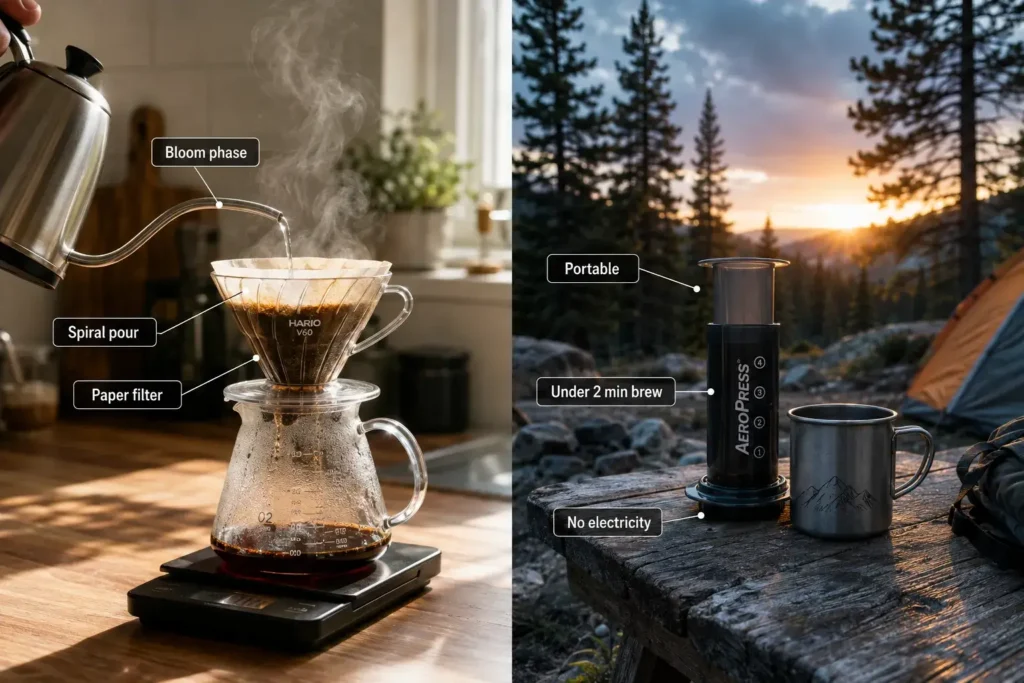
The AeroPress is the clear winner for travel and camping. It weighs under 7 ounces, requires no electricity, brews in under 2 minutes, and is nearly indestructible. A hand grinder and a small camp stove complete the kit.
The Moka pot is a strong second for camping with a gas stove, it produces a strong, espresso-like brew and costs under $40. Pour over is also viable with a collapsible dripper and paper filters, though it requires more precise water control.
Avoid for travel: Drip machines (need electricity), standard espresso machines (fragile, heavy), and cold brew (requires 12+ hours and refrigeration).
What’s the Easiest Coffee Brewing Method for Busy Mornings
An automatic drip machine with a programmable timer is the easiest method for busy mornings. Grind beans the night before, set the timer, and coffee is ready when you wake up with zero active effort. For those without a drip machine, a French press is the next easiest, add coarse grounds, pour hot water, wait 4 minutes, and press.
AeroPress is the fastest manual option at under 2 minutes, but it requires full attention during brewing. Guides focused on practical home brewing consistently rank programmable drip machines as the most used method in households precisely because they eliminate all morning decision-making.
How Many Times Can You Reuse Coffee Grounds
Used coffee grounds should not be reused for a second full brew. The first extraction pulls the majority of soluble flavor compounds, leaving behind mostly bitter, woody material. A second brew produces a thin, harsh, unpleasant cup.
The one exception is intentional double-brewing techniques like “coffee concentrate,” where the second pass is used as a flavor base for cooking or cold brew experiments, not as a drinking cup. For best results, always start with fresh grounds.
Frequently Asked Questions
What is the healthiest coffee brewing method?
Pour over and drip coffee made with paper filters remove most cafestol and kahweol, the diterpene compounds in coffee oils linked to LDL cholesterol increases. French press and espresso retain more of these oils. For cardiovascular health, filtered methods are generally preferred.
Which brewing method produces the most caffeine?
Cold brew concentrate and French press tend to produce the highest caffeine per serving due to longer contact time and higher coffee-to-water ratios. A standard espresso shot has less total caffeine than an 8 oz drip coffee, despite being more concentrated per ounce.
Is a burr grinder necessary?
For pour over and espresso, yes, a burr grinder produces consistent particle size, which is critical for even extraction. For French press and cold brew, a blade grinder is acceptable but a burr grinder still improves results noticeably.
What water temperature is best for coffee brewing?
Most brewing methods perform best between 195°F and 205°F (90°C to 96°C). Boiling water (212°F) can over-extract and increase bitterness. Cold brew is the exception, using room temperature or refrigerator-cold water.
Does the type of water matter?
Yes. Filtered water with moderate mineral content (around 150 ppm TDS) extracts coffee more evenly than distilled water (too flat) or hard tap water (too mineral-heavy). Many specialty coffee shops use water filtration systems specifically for this reason.
What’s the best method for single-origin specialty beans?
Pour over is widely considered the best method for showcasing single-origin beans because it preserves clarity, highlights origin-specific flavors (fruit, floral, terroir), and allows precise control over every variable.
Can I make espresso without an espresso machine?
A Moka pot produces a strong, concentrated brew that resembles espresso in strength but lacks the crema and true pressure-extracted body. AeroPress with a fine grind and short brew time also approximates espresso. Neither is a true substitute, but both are much cheaper.
How do I choose between a Chemex and a V60?
Both are pour over methods. The Chemex uses a thicker filter that removes more oils, producing an exceptionally clean and mild cup. The V60 uses a thinner filter and allows slightly more body. Choose Chemex for the cleanest cup; choose V60 for more flexibility and faster brewing.
What’s the best method for making coffee for a group?
An automatic drip machine with a carafe is the most practical for groups of 4 or more. A large French press (8-cup size) is a good manual alternative. Pour over and AeroPress are single-serving methods and become tedious at scale.
Is cold brew the same as iced coffee?
No. Iced coffee is hot-brewed coffee poured over ice (which dilutes it). Cold brew is never exposed to heat, it’s steeped in cold water for 12 to 24 hours, producing a naturally sweeter, less acidic concentrate that’s then diluted with water or milk.
Conclusion : What Are the Best Coffee Brewing Methods and Their Differences
Understanding what are the best coffee brewing methods and their differences comes down to matching technique to your priorities. For clean, nuanced flavor from specialty beans, pour over is the benchmark. For everyday ease, a drip machine or French press wins. For strength and concentration, espresso or cold brew concentrate leads. For travel and flexibility, AeroPress is unmatched.
Actionable next steps:
- Start with one method that fits your morning routine, don’t buy multiple brewers at once
- Invest in a burr grinder before upgrading your brewer; grind consistency has the biggest impact on cup quality
- Match your grind size to your method using the guidelines above, and adjust by taste (coarser if bitter, finer if weak)
- If your coffee tastes off, change one variable at a time, grind size first, then temperature, then ratio
- Once comfortable with one method, try a contrasting category (e.g., if you use French press, try pour over) to understand how brewing physics shapes flavor
The best brewer is the one you use consistently with fresh beans and the right grind. Start simple, dial it in, and build from there.